

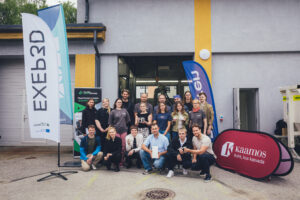
The student competition Betooniprint 2026 concluded on 28 August at Tallinn University of Applied Sciences, bringing together students, researchers and industry experts to explore the practical possibilities of 3D concrete printing.
This year’s competition was organised by INSA, with EXEP3D participating as an integral project partner and providing expertise in 3D concrete printing, digital manufacturing and practical implementation. The collaboration gave student teams an opportunity to develop their ideas from initial concepts into full-scale, digitally manufactured concrete products while working directly with 3D concrete printing technology.
The winning project was created by a team from Pallas University of Applied Sciences, consisting of Lill Kagadze, Villiam Sillanurm, Greete Sallo and Annabel Seen. Their project, “Süss”, is a modular outdoor kitchen whose individual elements can be combined in different configurations to support a variety of uses.
Following the announcement of the results, the winning design was manufactured at the 3D Concrete Printing Laboratory of Tallinn University of Applied Sciences. This final stage allowed the students to see how their digital concept translated into a full-scale concrete object and to experience the practical requirements of additive manufacturing first-hand.
Team representatives Lill Kagadze and Villiam Sillanurm described the experience:
“We are still recovering and trying to understand that all of this really happened. We are extremely happy with the printed result. All the complications we were worried about were successfully resolved, and seeing our idea actually printed in concrete is truly incredible!”
The completed work will also be presented to a wider audience at the 21st Design Night Festival (Disainiöö), taking place from 28 September to 4 October 2026.
From concept to full-scale production
Betooniprint 2026 brought together student teams from four Estonian higher education institutions. During the competition week, the teams were challenged to develop a practical concrete element suitable for additive manufacturing.
The programme began on 24 August with an introductory thematic day covering the principles, possibilities and constraints of 3D concrete printing. This was followed by a two-day hackathon, during which the teams developed their concepts into feasible solutions with support from mentors and specialists.
EXEP3D contributed its expertise in 3D concrete printing, digital design, material and process constraints, and automated production throughout the competition. This provided students with direct access to knowledge and infrastructure developed through the project and enabled them to test their ideas against the requirements of real-world manufacturing.
The competition therefore offered more than a design exercise. Students had to consider how architectural and visual ideas interact with material behaviour, printability, geometric constraints and production strategy, demonstrating the interdisciplinary nature of additive construction.
For EXEP3D, participation in activities such as Betooniprint is an important part of transferring knowledge beyond the research environment. It connects expertise developed within the project with education, industry and emerging designers and engineers, while providing a practical setting for testing new approaches to 3D concrete printing.
Combining design quality and technological understanding
The competition entries were evaluated by a jury representing education, research and industry. The jury consisted of Vaido Leosk from the Estonian Concrete Association, Priit Pallum from Weber Estonia, Aivars Alt and Gustav Gerretz from Tallinn University of Applied Sciences, and Lauri Hass and Karsten Nefs from Eindhoven University of Technology.
According to jury member and lead organiser Aivars Alt, the winning project demonstrated a particularly strong understanding of the technology:
“Süss clearly distinguished itself through a well-considered solution that takes into account the technological and material-specific characteristics of 3D concrete printing. The project also stands out for its attractive visual design, giving it the potential to compete with products already available on the market.”
Betooniprint 2026 was organised by INSA at Tallinn University of Applied Sciences, in close cooperation with EXEP3D and the competition’s industry partners. The event was supported by Saint-Gobain Weber Eesti, NOBE, Embach Ehitus, Mapri Ehitus, Savekas, Bildgren Ehitus and Kaamos Ehitus.
The cooperation demonstrates how educational initiatives and research projects such as EXEP3D can complement each other: combining student learning, research expertise, advanced manufacturing infrastructure and industry involvement in a shared practical environment.